Annex I: User-specific licence options for national data uploaded to the UNCCD Performance Review and Assessment of Implementation System (PRAIS)
1. UNCCD Mandate
Decision 16/COP.11 para. 9 requests the secretariat to ensure that data and information from the reporting process are available and accessible to all, especially at the national and local levels.
Decision 17/COP.11 para. 14 requests the secretariat to develop a policy to access data and information provided by Parties and other reporting entities, including through the Performance Review and Assessment of Implementation System (PRAIS), building on the practices and policies of other conventions and multilateral bodies, and to utilize intellectual property provisions to protect innovations submitted as best practices while implementing this data access policy.
2. Submitting national datasets to PRAIS
There are three mechanisms to share non-default reporting datasets in PRAIS:
Uploading data directly to PRAIS and supplying metadata (information about the dataset) on the forms provided;
Via data transfer from Trends.Earth (when using national data for calculating UNCCD indicators in Trends.Earth);
Creating spatial reporting data on the Spatial Data Viewer in PRAIS.
3. Licence Instructions
3.1. Creative Commons Licences for National Reports
The Creative Commons (CC) licences are a well-developed, tested suite of licences that are standard for sharing data. The licence options available to Parties in the PRAIS User Specific Licence (USL) form are– from most open to most restrictive – CC BY, CC BY-SA, CC BY-NC and CC BY-NC-SA. Each licence requires one or more of the following conditions:
Attribution (BY): Attribution is important to give you credit for the data and show its provenance. It is a required condition for all CC licenses.
Share Alike (SA): This condition indicates that any new content created by combining this data, has to be shared under the same SA licence. This is to ensure that the data stays reusable when combined with data licensed under the same terms, but may make it difficult to reuse when combined with data licensed without the SA condition and under more open terms. In short, SA-licensed work is able to be remixed, but only into other SA outputs.
Non-Commercial (NC): This condition indicates that the data can be reused and combined, but not for commercial purposes. This ensures that corporations cannot make profit on your data, but there are use cases that are not so clear-cut and may hinder reuse that you would be okay with.
Additionally, the Creative Commons Universal Public Domain Dedication 1.0 (CC0) is available for waiving copyright and dedicating data to the worldwide public domain. See https://creativecommons.org/publicdomain/zero/1.0/deed.en for further information.
Figure 10 provides an overview of the public domain dedication and each Creative Commons licence and whether they allow remixes, commercial use, free cultural works and if they meet the ‘open’ definition.
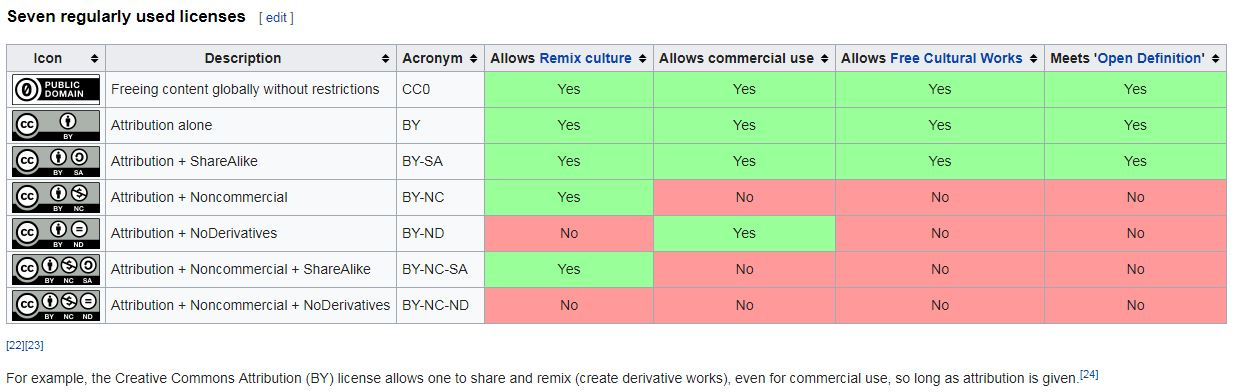
Figure 10. Overview of various CC license options (source: Wikipedia, further information can be found at https://creativecommons.org/share-your-work/cclicenses/)
As explained in the introduction of this reporting manual, Parties are strongly recommended to maximize the interoperability and impact of their reported data and support legal, confident, and consistent reuse of national data by the secretariat. Therefore, they are encouraged to select an open licence for their national country Party data, choosing either:
The Creative Commons Universal Public Domain Dedication 1.0 (CC0). See https://creativecommons.org/publicdomain/zero/1.0/deed.en for further information;
The open Creative Commons Attribution 4.0 International (CC BY) licence, which means users of the data are free to:
Share — Copy and redistribute the material in any medium or format.
Adapt — Remix, transform, and build upon the material.
However, in return for using the data, users must respect the following terms:
Attribution — Users must give appropriate credit, provide a link to the licence and indicate if changes were made. Users may do so in any reasonable manner.
See https://creativecommons.org/licenses/by/4.0/deed.en for further information (translated into all United Nations languages).
Either of these options will ensure national data can be legally, confidently, and consistently reused across systems for better tracking of global and regional status and trends in land degradation and drought and for seamless data sharing with UNCCD partners.
However, licences with the SA constraint are NOT recommended as it makes reuse of the national report more complicated due to the need for licence stacking - combining multiple licenses with different and sometimes conflicting use conditions. For example, the secretariat will not be able to use national reports licensed with NC-SA or SA in the regional and global aggregate statistics and maps that are licensed with the BY-NC.
For these reasons, Parties that license data with SA must grant the secretariat explicit permission on the User Specific Licence (USL) form to use that data in regional and global aggregates. Alternatively, if none of the Creative Commons licenses are appropriate, Parties can report a custom licence, but still must grant the secretariat explicit permission on the USL form to use that data in regional and global aggregates.
3.2 User Specific Licence (USL)
Taking the explanation of the licence options provided in section 3.1 into account, Parties should select a User Specific Licence (USL) to determine the terms of use of the Data contained in their national reports by filling out the licence form provided in PRAIS, which can be accessed from the “Spatial Layers” tab or directly from the country “Overview” page in the list of menu items on the right hand side.
By choosing a USL, the user consents to the chosen licence. It is understood that the following terms and conditions are agreed to:
Nothing in or relating to this USL shall be deemed a waiver, express or implied, of any of the privileges and immunities of the United Nations Convention to Combat Desertification (UNCCD) or the United Nations, including its subsidiary organs.
The name and emblem of the UNCCD is the property of the UNCCD, which owns all rights to its use. The logo can only be used to identify events and activities related to the UNCCD.
The UNCCD shall not be held responsible for any use of information beyond that stipulated in this USL, where prior authorization was not sought and granted in accordance with the conditions expressed and communicated by the UNCCD. The USL will determine the conditions of reuse of national datasets hosted on PRAIS and managed by the UNCCD secretariat for the purposes of national reporting. For the purposes of this agreement, the “Data” comprises any national data, with particular recognition of spatial data and associated attribute data provided by the country Party in the reporting process to the UNCCD through its creation on the PRAIS Spatial Data Viewer, using the PRAIS upload tool or via Trends.Earth or other third party software tools. The Data will be used in regional and global aggregate maps, statistics and other information products by the secretariat, in fulfilling its mandate under Decision 11/COP.14, and may be provided to partners of the UNCCD on request and on the understanding that they read and consent to be bound by the terms and conditions of use set out in the USL (if the data is not already in the public domain or its source licence applies additional restriction on use of the data).
Therefore, country Parties should familiarize themselves with the options described above and fill out the licence form accordingly.
Parties should note that if no USL form is submitted then the default CC BY-NC 4.0 license will apply to the submitted Data.